| Author | Affiliation |
|---|---|
| William J. Peterson, MD | Academy of Michigan, Department of Emergency Medicine, Ann Arbor, Michigan |
| Laura R. Hopson, Medico | University of Michigan, Department of Emergency Medicine, Ann Arbor, Michigan |
| Sorabh Khandelwal, MD | The Ohio State University College of Medicine, Section of Emergency Medicine, Columbus, Ohio |
| Melissa White, MD, MPH | Emory University, Department of Emergency Medicine, Atlanta, Georgia |
| Fiona E. Gallahue, MD | University of Washington, Department of Emergency Medicine, Seattle, Washington |
| John Burkhardt, MD | University of Michigan, Department of Emergency Medicine, Ann Arbor, Michigan |
| Aimee M. Rolston, Medico | University of Michigan, Department of Obstetrics and Gynecology, Ann Arbor, Michigan |
| Sally A. Santen, Doc, PhD | University of Michigan, Department of Emergency Medicine, Ann Arbor, Michigan |
Introduction
Methods
Results
Word
Limitations
Conclusion
Abstract
Introduction
This study investigates the touch on of the Doximity rankings on the rank listing choices fabricated past residency applicants in emergency medicine (EM).
Methods
We sent an 11-item survey by e-mail to all students who practical to EM residency programs at four dissimilar institutions representing various geographical regions. Students were asked questions about their perception of Doximity rankings and how it may have impacted their rank list decisions.
Results
Response rate was 58% of i,372 opened electronic surveys. This study constitute that a majority of medical students applying to residency in EM were enlightened of the Doximity rankings prior to submitting rank lists (67%). 1-quarter of these applicants changed the number of programs and ranks of those programs when completing their rank listing based on the Doximity rankings (26%). Though the absolute number of programs changed on the rank lists was minor, the results demonstrate that the EM Doximity rankings impact applicant decision-making in ranking residency programs.
Determination
While applicants do not find the Doximity rankings to exist of import compared to other factors in the application procedure, the Doximity rankings result in a small change in residency bidder ranking behavior. This unvalidated ranking, based principally on reputational data rather than objective consequence criteria, thus has the potential to be detrimental to students, programs, and the public. We feel information technology important for specialties to develop consensus around measurable training outcomes and provide freely attainable metrics for candidate teaching.
INTRODUCTION
Background
Influences on applicant rank lists have been well studied; however, the advent of the new Doximity ranking organisation may have introduced new considerations. Studies have shown that applicants base their decisions on a combination of personal factors including geographic location and quality of life, likewise as plan-specific factors including expected clinical experience, curriculum quality, interview day, feel with residents and faculty, and reputation of program.1- 5 This process leads to an of import decision that volition impact the bidder's time to come do and location.6
In the 2014 application cycle, Doximity released residency plan rankings by specialty in collaboration with U.S. News and World Report.vii Doximity is a free, HIPAA-compliant online platform for physicians' social networking, collaboration and education. To create the residency rankings, Doximity administered a survey to their physician network in which they asked practicing physicians to "nominate up to 5 residency programs in your medical specialty that offering the best clinical training.eight " More than than 17,000 Doximity members responded to the survey, which resulted in a list of programs ranked by number based on majority vote. No independent consensus exists as to metrics for quality of training. The creation of a ranking arrangement based on potentially biased responses from a selected group of physicians is controversial and has raised significant concerns, especially in the emergency medicine (EM) community.9
Importance
The touch of U.Southward. News and Globe Report rankings on the undergraduate higher awarding process has been well studied and has been shown to affect applicant decision-making, as well every bit public perception of universities and the funding that universities receive, regardless of debates about its accurateness. ten Prior to the Doximity emergency medicine residency listing being published, no central ranking system existed for residency applicants to refer to and to potentially impact their rank list.
Goals of this Investigation
The effects of the Doximity findings, which have both reputational and ranking implications, are not well studied. This new ranking system may issue in changes to applicants' selections of residency programs. An initial study indicated that applicants are using Doximity in their choice of programme applications. 11 This impact is potentially concerning, since there has been significant resistance to Doximity rankings in the EM community due to concerns about lack of objective criteria, inaccurate portrayal of residency programs, bias towards programs with larger alumni networks and provision of potentially misleading information to students also as patients in the community. 12 The objective of this study is to investigate the impact of the Doximity rankings on the rank listing choices made by residency applicants in EM.
METHODS
Study Blueprint, Participants and Setting
Design was an eleven-particular survey emailed to all students who practical to EM residency programs at four dissimilar geographically various institutions: University of Michigan (Midwest), Ohio State Academy (Midwest), Emory University (S), and Academy of Washington (Westward). These email addresses were obtained through ERAS with the permission of ERAS.
Methods, Measurements, and Outcomes
We assembled a research team consisting of ii assistant deans, 4 residency program directors, a clerkship director, a resident, and a fourth-year medical student. For content validity, we modeled the questions after previous studies.4, 11 The survey was reviewed past all authors with attending to response process and revised. For boosted content validity, the questions were modeled later previous studies on a similar population (fourth-year students applying to residency). That survey was piloted by 20 residents and faculty and revised for response procedure validity. All authors reviewed this survey with attention to response process. The survey was emailed to students using a spider web-based platform, Qualtrics™, and student responses were anonymous. The survey was initially distributed at the beginning of March 2015 subsequently rank lists were submitted by applicants and airtight before Match Day. Iii repeated requests were sent weekly to non-responders.
The survey asked commencement whether the student applicant was enlightened of or had looked at the Doximity rankings prior to submitting their rank list (Figure). Students who had looked at the rankings were eligible to consummate the questions that assessed whether the Doximity rankings impacted their rank list construction. Students were besides asked basic demographic information, how accurate they perceived the rankings to exist on a 100-point scale (0 beingness not accurate at all and 100 being very authentic), and whether they increased or decreased the rank of programs based on the Doximity rankings. Additionally, infinite was provided for students to comment about the Doximity rankings. The comments were qualitatively reviewed and categorized into 3 groups: negative impression of rankings, neutral, and positive impressions of rankings. The negative category independent statements about how Doximity rankings were perceived every bit inaccurate or biased. The neutral category independent comments where students were unsure or did not care nigh the rankings. The positive category independent comments about how Doximity rankings were helpful or perceived as authentic. Finally, respondents were asked what factors affected their choice of programs.
Effigy
Applicants who looked at rankings.
Analysis
Data analysis included descriptive statistics using SPSS 22. This study was determined to be exempt from institutional review board review at all four participating sites.
RESULTS
Characteristics of Report Subjects
We sent ane,641 emails to private applicants for EM resident positions; one,372 people opened the email, 850 started the survey, and 793 students completed the survey across the sample (overall response charge per unit of 93% of people who started the survey, 58% of people who opened the email and 48% of total emails sent). The demographics of this sample of applicants who looked at the rankings were as follows: 63% male, 73% self-identified as White, 11% Asian, 5% Hispanic, 4% Black or African American, 1% American Indian, and vii% other. The regions of the institutions from which the applicants applied included 25% Northeast, 29% South, 27% Midwest, and 18% West. From the National Residency Matching Program for 2015, there were 1,613 U. S. senior applicants and two,352 total applicants to EM.
Primary Results
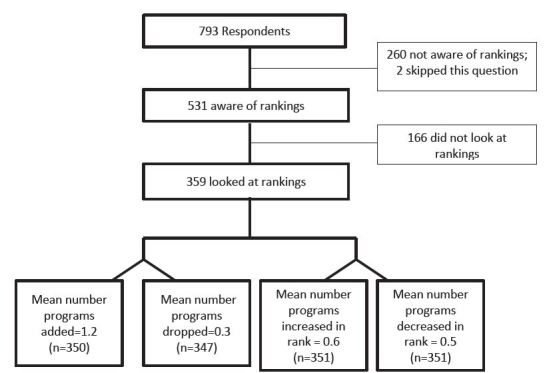
Among the respondents, 531 students (67%) were aware of the Doximity rankings prior to submitting their rank lists. Amid the students who were aware of the rankings, 359 (68%) looked at the rankings (Figure). Respondents found the Doximity rankings to be somewhat authentic with the mean score for accurateness of 41 (SD 23, range 0–100). Students were asked to "explain your assessment of the accuracy of the Doximity rankings." Comments varied widely from "worthless" and "completely subjective" to "seems authentic" to "I don't know." Of the comments, 65% savage into the negative impressions category, 35% were neutral, and ten% were positive.
Of the students who looked at the rankings, 26% added programs to their rank list and 9.8% dropped programs from their rank list (Figure). The mean number of programs added per applicant who looked at the rankings was ane.2 (range 0 to >10) and the hateful number of programs dropped was 0.3 (range 0 to seven). Nonetheless, for those students who did add together or drop programs to their rank list based on the rankings, the mean number added was 2.15 (SD two.xl) and dropped 1.31 (SD ane.07). Similarly, 26% of students increased the rank of programs on their rank listing based on the Doximity rankings, and 19% decreased the rank of programs on their rank listing. The mean number of programs that an applicant who looked at the Doximity rankings increased in rank was 0.6 programs (range 0 to 10), and the mean number of programs the applicant decreased in rank was 0.v programs (range 0 to 8). For those students who changed their rank list based on the Doximity rankings, the mean increase in rank was one.60 (SD i.34) and decrease ane.46 (SD 1.14).
Students' relative value of factors affecting residency preference are noted in Tables 1 and 2. They included preference for a particular geographic location, listed interview experience and experience with residents.
Table 1Factors of importance affecting choice of residency programs to which medical students applied.
| Number (%) n=772 | |
|---|---|
| Geographical preference | 693 (90%) |
| Interview experience | 636 (82%) |
| Experience with residents | 596 (77%) |
| Proximity to spouse/meaning other/family | 439 (57%) |
| Doximity rankings | 41 (5%) |
Table 2Factors important in making a rank listing (rank those selected in question above).
| Factor | Number of respondents placing factors in certain ranking | ||||
|---|---|---|---|---|---|
| | |||||
| 1st | 2nd | 3rd | 4th | 5th | |
| | |||||
| Interview experience | 183 | 174 | 134 | 30 | 0 |
| Geographical preference | 175 | 168 | 161 | 49 | 0 |
| Doximity rankings | 0 | three | 9 | 13 | 12 |
| Experience with residents | 109 | 158 | 141 | 78 | iv |
| Proximity to spouse/pregnant other/family | 133 | ninety | 71 | 88 | one |
DISCUSSION
This written report plant that a bulk of medical students applying to residency in EM were enlightened of the Doximity rankings prior to submitting rank lists. A substantial number of applicants looked at the rankings and about a quarter of these applicants changed the number of programs and ranks of those programs when completing their rank listing. Notably, the Doximity rankings were the least of import gene compared to the other factors assessed in this study (Table 1). While these rankings were the least important, applicants did brand changes in their rankings because of Doximity, demonstrating that the Doximity rankings may have some touch on in applicant decision-making in ranking residency programs. A previous study similarly found that Doximity rankings affected the number of programs to which students practical. xiii We did not assess final match position of applicants, and without that information we cannot comment on how the Doximity rankings may have impacted concluding lucifer position of applicants.
In that location has been significant resistance to the Doximity rankings in the EM community due to concerns about lack of objective criteria and inaccurate portrayal of residency programs. A consensus statement against the Doximity rankings endorsed past all major EM organizations was recently released in response to the rankings. The alphabetic character highlighted the significant threats to the validity of Doximity's polling methods including the run a risk of sampling bias since EM doc survey responses were generated from Doximity members recruited through social media. xiv It further emphasized to applicants the importance of looking at programs for fit versus an arbitrary ranking system.
Despite the concerns expressed by the EM community and by students directly through their comments in our study, the existence of Doximity rankings allows students to make inferences about the reputation and value of programs based solely on these rankings and allows institutions to lay claim to reputation besides. Information technology is well documented that reputation affects decision-making, and although the upshot size is small, our report supports that applicant perception of reputation through rankings may bear upon their decision-making with residency rank lists.xv, 16 Medical students believe their program's reputation will touch on their future career prospects and the medical school faculty consider a school'southward reputation in terms of their own visibility and the opportunities for career advancement, resource and research.
At that place is a stiff involvement on the office of students and EM programs for authentic, objective data near training programs. The inclusion of objective data could help guide applicants in selection of the best grooming environment for each learner. However, objective data for residency programs is limited and varies, and at that place is likewise the question of what data to include for a ranking system and more importantly, whether programs are willing to be transparent with certain information. Board passage rates were included in the Residency Navigator by Doximity for programs in internal medicine, family unit medicine, surgery and pediatrics. While markers like these are oftentimes considered by trainees and programs as indicators of successful training, these data speak to a single facet of training.
Our study too confirms the results of a previous written report by Love and colleagues 4 that students are choosing programs based on personal factors such as geography and experiences. This may be due to the absenteeism of objective data to assist controlling. While it would be preferable to focus on objective data in lieu of rankings, we know from previous enquiry (including this study) that rankings impact controlling, and now Doximity has introduced an Net-searchable residency ranking system that most applicants are enlightened exists. Perhaps efforts can exist made to shift the way these rankings are generated and to promote searchable objective data virtually programs so that applicants can improve identify the characteristics of programs that fit their individual interests and needs rather than creating an bogus roster of program superiority. Efforts to identify useful objective data, collect that data, and disseminate it in an hands navigable and Cyberspace-searchable class could tremendously benefit pupil applicants by providing a set of metrics to evaluate and characterize programs in a transparent way. Other specialties have previously initiated piece of work on this. 17 At that place is currently a report in progress looking to build consensus around a fix of reportable metrics that may allow applicants to rank programs co-ordinate to their needs and expectations of a programme, such as per centum of grads who proceed to academic practise.
LIMITATIONS
Response rate is a limitation of this study, with only 793 students completing the survey out of an initial 1,641 students who were emailed, and may limit generalizability and provide response bias. It is possible that students chose to complete or non complete the survey based on preconceived perception of Doximity. Recall bias is another limitation in any survey-based report. Students may not think exactly how Doximity afflicted their rank lists, as this survey was distributed afterward students had already submitted their lists. Another limitation is that students may not be able to adequately mensurate the affect of Doximity on their list choices since they exercise not have a personal comparison of applying prior to the release of Doximity.
CONCLUSION
In conclusion, while applicants exercise not find the Doximity rankings to be important compared to other factors in the application process, the Doximity rankings result in a small change in residency applicant ranking beliefs. This unvalidated ranking, based principally on reputational data rather than objective event criteria, thus has the potential to exist detrimental to students, programs, and the public. Nosotros feel information technology important for specialties to develop consensus around measurable training outcomes and provide freely accessible metrics for candidate didactics. In improver, there should be a greater emphasis on student advising and matching to a best-fit plan rather than to the almost highly ranked one.
Footnotes
Section Editor: Marker I. Langdorf, Physician, MHPE
Total text available through open up admission at http://escholarship.org/uc/uciem_westjem
Address for Correspondence: William J. Peterson, MD, Academy of Michigan, Department of Emergency Medicine, TC B1382, 1500 Eastward Medical Center Dr, Ann Arbor, MI 48109-5002. Email: wpet@med.umich.edu. 5 / 2016; 17:350 – 354
Submission history: Revision received January 12, 2016; Submitted March 15, 2016; Accepted April i, 2016
Conflicts of Interest: Past the WestJEM article submission agreement, all authors are required to disembalm all affiliations, funding sources and financial or management relationships that could be perceived as potential sources of bias. The authors disclosed none.
REFERENCES
one. Davydow D, Bienvenu OJ, Lipsey J, et al. Factors Influencing the Pick of a Psychiatric Residency Programme: A Survey of Applicants to the Johns Hopkins Residency Program in Psychiatry. Acad Psychiatry. 2008;32(2):143-146.
2. DeSantis M, Marco CA. Emergency Medicine Residency Selection: Factors Influencing Candidate Decisions. Acad Emerg Med. 2005;12(6):559-561.
three. Lee J, Alfieri K, Patel T, et al. Choosing family unit medicine residency programs: What factors influence residents' decisions?. Tin can Fam Physicians. 2011;57(3):e113-e121.
iv. Love JN, Howell JM, Hegarty CB, et al. Factors That Influence Medical Student Selection of an Emergency Medicine Residency Program: Implications for Training Programs. Acad Emerg Med. 2012;nineteen(4):455-460.
5. Stefanidis D, Miles WS, Greene FL. Factors Influencing Residency Choice of General Surgery Applicants—How Important is the Availability of a Skills Curriculum?. J Surg Educ. 2009;66(half dozen):325-329.
six. Doc Specialty Data Book. 2012. Bachelor at: https://http://www.aamc.org/download/313228/data/2012physicianspecialtydatabook.pdf. Accessed Oct 25, 2014.
7. About Doximity. Available at: https://http://www.doximity.com/about/company. Accessed Oct 25, 2014.
8. Harder B, Heilbrunn East. Doximity's 'Residency Navigator' Injects Transparency into GME. 2014. Available at: http://health.usnews.com/health-news/blogs/2d-opinion/2014/09/10/doximitys-residency-navigator-injects-transparency-into-gme. Accessed October 25, 2014.
ix. Articulation EM Organization Letters Regarding Doximity Medical Student Survey. 2014. Bachelor at: http://www.cordem.org/i4a/pages/index.cfm?pageid=3359. Accessed Nov 1, 2014.
x. Meredith M. Why Exercise Universities Compete in the Ratings Game? An Empirical Analysis of the Effects of the U.Due south. News and World Report College Rankings. Research in Higher Education. 2004;45(5):443-461.
11. Rolston AM, Hartley SE, Khandelwal S, et al. Effect of Doximity Residency Rankings on Residency Applicants' Programme Choices. West J Emerg Med. 2015;16(k):889-893.
12. Firm H, Gore Fifty. Emergency Medicine Objects to Methodology of Residency Rankings Published past Doximity and U.Southward. News & Earth Study. ACEP At present 2014. Available at: http://www.acepnow.com/commodity/emergency-medicine-objects-methodology-residency-rankings-published-doximity-u-south-news-world-report/. Accessed Sep 1, 2015.
13. Bassin BS, Sikavitsas A, Benner CA, et al. Development and evaluation of a multidisciplinary simulation based crisis direction curriculum. Acad Emerg Med. 2013;twenty:S301.
fourteen. Rosenau AM, Mercer M, Mitchell M, et al. Letter to Mr. Ben Harder, USNWR. 2014. Available at: http://saem.org/docs/default-source/default-document-library/finalusnewsletter.pdf?sfvrsn=2. Accessed October 25, 2014.
15. Harvey Due north, Fischer I. Taking Advice: Accepting Assist, Improving Judgment, and Sharing Responsibleness. Org Behav Human Decision Proc. 1997;70(2):117-133.
xvi. Meshi D, Biele 1000, Korn CW, et al. How Expert Communication Influences Determination Making. PLoS One. 2012;7(11):e49748.
17. Residency Directory. Available at: https://http://www.apgo.org/student/residency.html. Accessed Oct 25, 2014.
DOWNLOAD HERE
Posted by: dawsongreerierelf.blogspot.com


0 Komentar
Post a Comment